
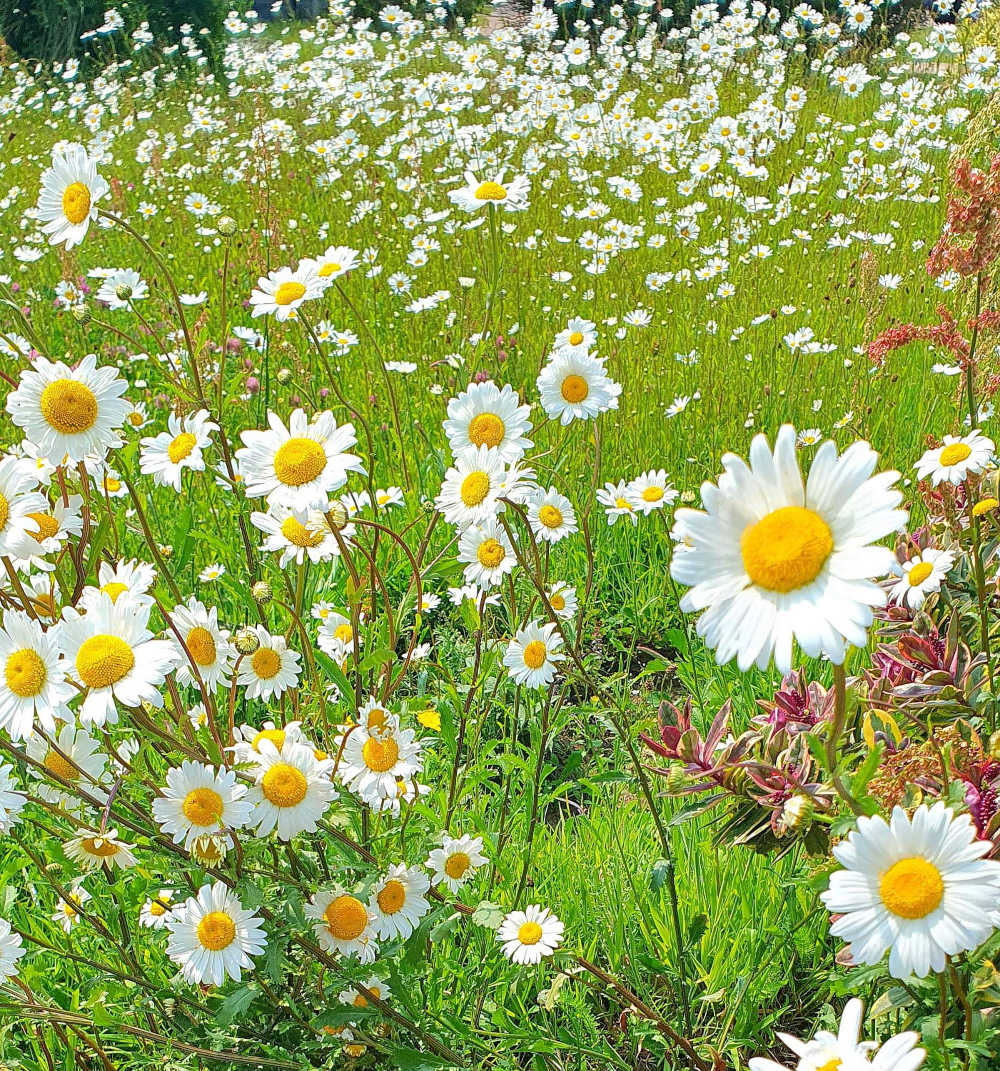
This picture was taken the other day as I was on a quick stroll. Oxeye Daisies never fail to uplift. A couple of years ago I might have appreciated wildflowers with only my eyes. These days, I also take a moment to appreciate their scent…
The more we become fixated on our busy routines and commitments, the less we notice about our environments – and that adversely effects our well-being.
A UK study reported by Mental Heath Foundation (mentalhealth.org) showed that 85% of adults agreed that being outside genuinely makes us happy, and 91% said green spaces are beneficial for mental health.
Being aware of our environments is crucial to anchoring us in the moment, and being out in nature can be particularly restorative. So often, we become lost in our worries and problems, and it can be easy to forget that there’s a wider, fuller world out there, beyond the bill that’s dropped onto our doormat, or the deadline that’s looming up. For this reason, I’ve made a concerted effort over these past two or three years to stop and smell the roses – quite literally.
For most of my adult life, I’ve been unable to use my sense of smell. In fact, I had been unable to breath through my nose at all, due to a football injury that misaligned my septum. But then I discovered a book called “Breath”, by James Nestor. This book taught me that I could, with practice, reshape the inner cavities of my sinuses in order to allow unrestricted nasal breathing once more.
The effect was transformative. I shall go into the details of the health benefits in a later post, suffice to say that I can now breath easy once more, and after more than twenty years, I can actually smell the world around me. The world has gained an extra dimension.
Being able to detect the scents of cut grass, or salty sea air, or wet foliage after rain has completely transformed my experience of the world. Walking past a bakery, or a restaurant cooking garlic, may mean trouble for my wallet, but for my soul it’s part of a wider reawakening for me.
One of the great pleasures I have newly acquired has been the discovery of wildflowers, and their rich library of mind-altering scents. For most of my adult life, I haven’t paid too much attention to wildflowers, other than appreciate the dash of colour they add to the landscape. I have always loved nature, but had never felt the need to learn their names, until their scent brought them to life for me.
Now, as I take my walks into the wild, I stop every now and then to experience the rich bouquet on offer. Week, on week, throughout most of the year, there is an ever-changing palette of aroma to be sampled. Like a wine connoisseur, I have become addicted to this new and previously undetectable realm that wafts all about me.
How can I find the scent of wildflowers so pleasurable? As I sink my nose into their petals, each one bursts like a firework in my mind. More than this, it brings the surrounding environment to life. If I am stuck in a cycle of negative thoughts or stressing over the coming week, a flower can bring me back into the moment. It shows me that there’s more to life than my own woes. The act of choosing to become aware of my environment is a powerful way to gain a sense of perspective and well-being.
I heartily recommend taking the effort to smell the flowers you pass, on your way to work, in your lunch hour, at weekends in nature, in your garden, whilst walking the dog. Anywhere. Common weeds like dandelions and buttercups have their own sweet smell. Blossoming trees, such as cherry or elderberry are delectable. Tiny pin flowers, of the sort that pop up in the cracks of walls and pavements, each have their own fascinating aroma. And of course, the vast array of wildflower that springs from every verge from April through to September and even beyond, such as Red Campion, Meadowsweet or Honeysuckle offers a world of stimulation.
Our sense of smell is incredibly potent. Whilst our eyes have three types of colour receptors, our noses have four hundred, meaning we can detect up to one trillion different kinds of scent. Truly mind-boggling. More than this, our olfactory sense forms a direct pathway to memory and emotion centres, making it neurologically potent, offering great opportunities for regulating our sense of well-being.
Smelling flowers seems like such a trivial suggestion, when we have plenty of serious real-world problems to tackle each week, but I urge you to give it a try.
Don’t discount the little pleasures in life, sometimes they are the very bedrock of what makes us happy. Happiness, isn’t our crowning achievements, or the day we get promoted, or can finally afford that fancy car. These kinds of happiness come rarely, and are over quickly. For sustained happiness that can keep us afloat every day of the year, we need to be mindful of the low-hanging fruits (or flowers) that are surrounding us everywhere.
We’re often told to “keep our eyes on the prize” – encouraged to foster a kind of laser focused tunnel vision on the biggest ambitions in our lives, at the expense of all other distractions. But I’d argue these very distractions are what offer us real happiness in everyday situations. Deferred happiness only raises the stakes, if this is our only source of reward. We risk missing out on all those small moments along the way that really matter. Spending time with loved ones, giving ourselves the time to let our hair down, experiencing things outside our usual palette – and yes: stopping to smell the roses. Try this important little trick today, and take your first step into a richer world.
Newsletter: About nature, mindfulness and happiness

Want to come for a walk? Join me as I explore the natural world and describe to you the fascinating things I find.
Slow down, escape your troubles, and let me whisk you away to somewhere calm…


Leave a Reply